Patchwork vs Splendor Duel: Head-to-Head Two-Player Board Game Showdown

Review by Lincoln Hoppe: The Game Bard

The Setup: Two Games, One Winner

It was time for a two-player showdown. I picked up both Patchwork and Splendor Duel, and my wife and I sat down to play them several times in a row, back to back. Both games had been on my radar for ages – I’d heard they were fantastic, but somehow I’d never gotten around to playing them. Well, that changed in one epic gaming session.
The good news? Both games are absolutely fantastic. But when you put them head-to-head, which one comes out on top? Let me break down what we discovered.

(Review text here is a quick Summary of the video)

“The elegance of Patchwork, the simplicity of it, the economy of what you’re doing and the simple choice in action – you’re either doing this or you’re doing that.”

Patchwork and Splendor Duel board games side by side showing components and game boards for head-to-head comparison review

Patchwork: Elegant Simplicity in Action
We started with Patchwork, and immediately I understood why this Uwe Rosenberg design has such a devoted following. The game revolves around a circle of polyomino tiles – think Tetris pieces with personality. Each tile has a cost (paid in buttons, which serve as currency) and most have little engine-building elements built right in.
Here’s the beautiful simplicity: when you buy a tile, you’re not just filling your personal grid (trying to cover as much space as possible). Those little button symbols on your tiles? They’re going to generate income every time you cross a button space on the time track. It’s engine building distilled to its purest form.
The gameplay loop is elegantly simple. On your turn, you can either buy a tile from the selection available (based on how many buttons you can afford) or advance on the time track to collect buttons equal to all the button symbols across your entire board. That’s it. Two choices, but each one matters enormously.
And then there’s the spatial puzzle element. Placing those polyomino pieces to maximize coverage while setting up future button income? Chef’s kiss – wait, I promised I wouldn’t use that phrase. Let me just say it’s deeply satisfying.
Patchwork and Splendor Duel board games side by side showing components and game boards for head-to-head comparison review

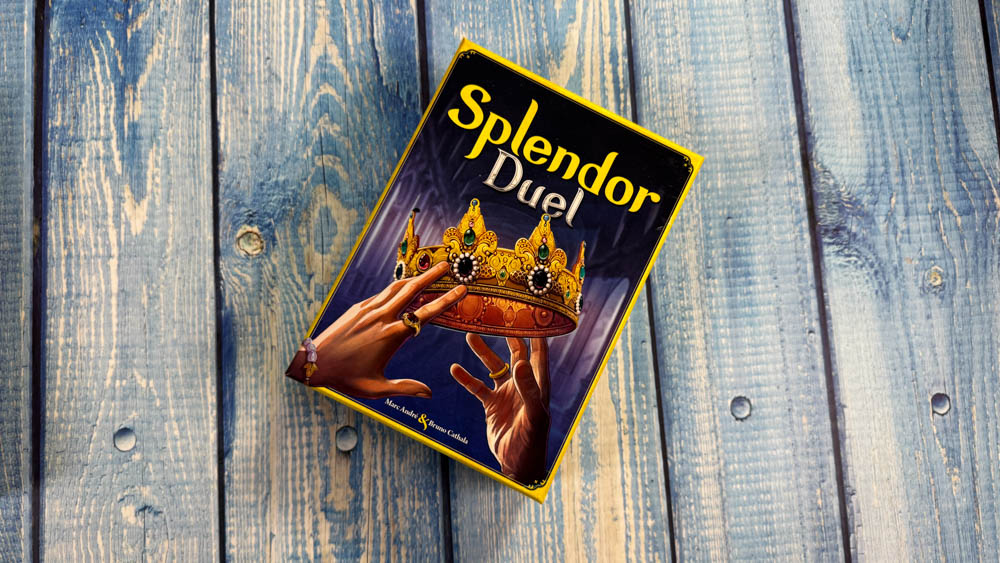
Splendor Duel: Complex Choices and Engine Building

Splendor Duel takes a different approach entirely. If you’ve played any game in the Splendor family, you’ll recognize the DNA, but this two-player version has its own personality. You’re working with beautiful gem chips (they feel like poker chips and look gorgeous) that you pull from a bag and arrange on a central board.
The goal is racing to trigger one of three end conditions: first to 20 points on cards, first to 10 crowns, or first to collect 10 of the same gem type in your tableau. Multiple paths to victory immediately create interesting tension.
Where Patchwork gives you two clear choices each turn, Splendor Duel opens up a menu of options. You can take three gems in a row (horizontally, vertically, or diagonally), you can buy cards for your tableau, and you have bonus actions available if you’ve earned privileges. There’s even a free action to reseed the board from the bag – though your opponent gets a privilege for your trouble.
The engine building here revolves around your tableau of cards. Each card you buy provides permanent gem discounts for future purchases, and some cards cost truly massive amounts – like eight red gems. Since there are only four of each gem type (except pearls, which are even scarcer), you literally cannot buy these expensive cards without building your discount engine first.
Patchwork and Splendor Duel board games side by side showing components and game boards for head-to-head comparison review

Head-to-Head: Which Game Comes Out on Top?

After multiple plays of each game, here’s where we landed: I prefer Patchwork by a small margin, while my wife prefers Splendor Duel. And honestly, both preferences make perfect sense.
Patchwork won me over with its elegant design philosophy. The economy is tight, the choices are meaningful but clear, and every decision feels weighty. You’re either buying a tile or advancing for income – that’s it. But within that simplicity lies incredible depth. The spatial puzzle of tile placement, the timing of when to take income versus when to buy, the engine building that happens almost automatically as you play… it all clicks together beautifully.
My wife gravitates toward Splendor Duel’s additional complexity. She loves having more options each turn, enjoys the tableau building aspect, and appreciates the multiple paths to victory. The game gives her more levers to pull, more ways to express her strategic thinking.

Why We Disagreed: Different Preferences for Different Players

I think our different preferences come down to how we like to engage with games. As someone who spends most of my time in creative pursuits – acting, writing music, composing – I love games that let me exercise the mathematical, logical part of my brain that doesn’t get as much workout in my daily life. Patchwork’s elegant simplicity scratches that itch perfectly.
The spatial puzzle element particularly appeals to me. While Splendor Duel has you building a tableau spatially, it’s not the same kind of geometric puzzle that Patchwork presents with its polyomino placement. There’s something deeply satisfying about finding the perfect spot for a weird-shaped tile that maximizes both coverage and future button income.
My wife, on the other hand, enjoys having more complex decision trees to navigate. She likes the privilege system in Splendor Duel, the scarcity tension around gems, and the multiple strategic paths the game offers. Where I see elegant simplicity, she sees missed opportunities for deeper engagement.

The Verdict: Both Games Win (But One Edges Ahead)

Here’s the thing – we’re talking about two genuinely fantastic games here. Both deserve spots in any two-player game collection. Patchwork runs a bit shorter in our experience, while Splendor Duel tends to play a bit longer, but both hit that sweet spot of meaningful decisions without overstaying their welcome.
If I had to choose just one (and thankfully I don’t), I’d reach for Patchwork. The elegance of the design, the tightness of the economy, and the satisfying spatial puzzle combine into something that feels almost perfect. Every move matters, the engine building happens naturally, and the core loop never gets old.
But ask me again in two weeks and I might feel differently. That’s the mark of two great games – they both offer enough depth and replayability that preferences might shift based on mood, opponent, or simply what kind of mental exercise you’re craving.
Both games are two-player only, both are fantastic, and both deserve consideration. The real winner? Anyone who gets to experience this particular head-to-head matchup.
What do you think? Have you played both games? Do you have a preference, or does it depend on your mood? Let me know in the comments – I’m genuinely curious whether other couples have had similar splits in preference!


Video Review Link 

by Lincoln Hoppe


Original Music by Lincoln Hoppe: The Game Bard


I purchased my own copies of these games. 


Patchwork Publisher: Lookout Games

Designed by:

Art by: atelier198, Carrie Cantwell, Klemens Franz, Maya Hanisch + 4 more

Board Game Geek Page: Patchwork


Splendor Duel Publisher: Space Cowboys

Designed by: , 

Art by: Davide Tosello

Board Game Geek Page: Splendor Duel

My Board Game Geek Page: Lincoln Hoppe

 

Lincoln Hoppe

Lincoln a professional film & Television actor based in Los Angeles, California.

He has a family with 5 kids, and one of his joys in life is playing games together as a family.

He's on a mission to spread the love and mental health benefits of play and board gaming to the world.
Email Me

lincoln@thegamebard.com

Website

theGameBard.com

The Game Bard Socials

Lincoln Hoppe Website

lincolnhoppe.com

Lincoln Hoppe Socials